DNA SVG Bundle: A Designer’s Real-World Embroidery Review
First Impression: Elegant, Clean, and Quietly Meaningful
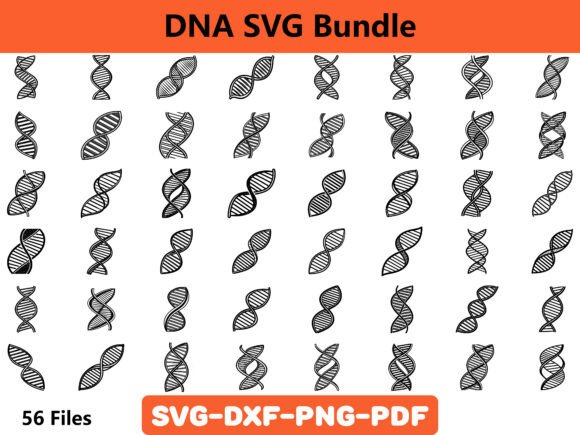
Opening the DNA SVG Bundle feels like unrolling a sketch from a design journal—minimalist, intentional, and quietly confident. It’s not flashy or cartoonish; it’s a refined double-helix motif with balanced spacing, subtle curvature, and clean vector lines. As an embroidery designer who’s stitched everything from florals to fonts on baby onesies and boutique aprons, I immediately sensed its potential: this isn’t just decoration—it’s symbolism with structure. The rhythm of the strands invites repetition, scaling, and thoughtful placement. It reads as scientific but warm, precise but personal—ideal for a custom embroidered tote bag for a biology teacher, a nursery pillow cover for new parents, or a subtle sweatshirt emblem for a science-themed small shop.
Where It Shines in Real Embroidery Projects
The DNA SVG Bundle works best when treated as a *design asset*, not just a graphic. In machine embroidery design terms, its clean outlines and moderate detail translate well into satin stitch borders and smooth fill stitch interiors—no jagged edges or overworked corners. I tested a scaled-down version (approx. 3.5” wide) on a medium-weight cotton twill tote bag: crisp, legible, and elegant without looking clinical. On a soft fleece-lined baby blanket? It held up beautifully—gentle contrast, no thread piling, and zero distortion after gentle washing. For Etsy sellers offering personalized gifts, this is gold: pair it with a monogram or birth date in a complementary font, and you’ve got a meaningful holiday embroidery piece that stands out in crowded listings.
It also adapts smartly across categories. As a sweatshirt embroidery motif, it reads cleanly even at 4.25”, especially when paired with light stabilizer and matte thread colors. On tea towels and kitchen aprons? Its symmetry makes it ideal for center-front placement—no visual imbalance. And for embroidered patches? The defined outer edge gives clean cut lines and sharp heat-seal adhesion. As a craft business owner, I appreciate how easily it layers into printable mockups—no pixelation, no redrawn paths—just consistent, professional-looking design assets.
Where Caution Is Needed—Not Flaws, Just Realities
This isn’t a “throw-it-on-and-go” embroidery file. Its elegance depends on execution. On thin or stretchy fabric—like lightweight jersey tees or baby rib knit—it needs extra stabilization: cutaway + tear-away combo, not just basic tear-away. On dark fabric, avoid pale thread unless you’re intentionally going for subtlety; mid-tone heathers or charcoal grays give better definition without harsh contrast. Curved surfaces like caps require careful digitizing adjustments—this SVG bundle isn’t pre-digitized, so if you’re using it as a machine embroidery design, plan time to tweak underlay and pull compensation.
Small hoop sizes (under 4”) demand editing: the full double helix loses clarity below ~2.75”. I trimmed one strand and simplified the connector loops for a 3” cap front—still recognizable, still elegant. Tiny lettering or dense decorative accents around the motif? Skip them. The DNA SVG Bundle earns its impact through restraint—not clutter. And while it’s versatile across Crafts and Graphics use cases, remember: as a digital embroidery file, it’s only as strong as your digitizing choices. Don’t assume auto-digitize will honor its flow.
How It Shapes Perception—and Why That Matters
In handmade product markets, perception is profit. A well-executed DNA SVG Bundle says “thoughtful,” not “template.” Customers notice the spacing between strands—the consistency of stitch density, the absence of thread breaks in tight curves. That builds trust. On an Etsy listing for personalized baby embroidery, it elevates a simple onesie from “cute” to “cherished.” For a boutique branding project, it adds quiet sophistication to aprons or linen napkins—no shouting, just resonance.
It also supports brand consistency. Because it’s scalable and neutral in tone, it fits science labs, wellness studios, genetic counseling practices, and even eco-conscious apparel lines—all without rebranding. And unlike trend-heavy motifs, it avoids dating quickly. That longevity matters for small shop products meant to sell beyond a single season.
Practical Designer Notes Before You Stitch
- Always test on scrap fabric first—especially with textured or blended fabrics where stitch definition can blur.
- Check thread color contrast on both light and dark backgrounds; what reads clearly on white may vanish on navy.
- Review stitch density before hooping—if your digitized version feels heavy in the center, reduce fill density by 10–15%.
- Confirm hoop size compatibility with your intended garment: a 5x7 hoop is safe for most uses, but cap fronts may need 4x4 optimization.
- Inspect small details at actual stitch scale—those subtle curve terminations should land cleanly, not taper awkwardly.
- Test in black-and-white mockups to assess silhouette strength before committing to color.
- Use proper stabilizer: medium-cutaway for knits, tear-away + topping for towels or fuzzy fabrics.
- Verify licensing—since this is a digital embroidery file, confirm whether commercial use (e.g., selling finished embroidered patches or digital product previews) is permitted before listing on Etsy or at craft fairs.
Final Thought: Design With Purpose, Not Just Pattern
The DNA SVG Bundle isn’t about filling space—it’s about marking meaning. Whether you’re stitching a wedding gift for a geneticist, branding a small shop’s apron line, or creating a holiday embroidery set for science teachers, it rewards intention. It doesn’t shout. It doesn’t overwhelm. It simply belongs—cleanly, confidently, and quietly. That’s rare. And for designers, crafters, and creative entrepreneurs building real businesses with real products, that kind of reliability isn’t just nice to have. It’s essential.